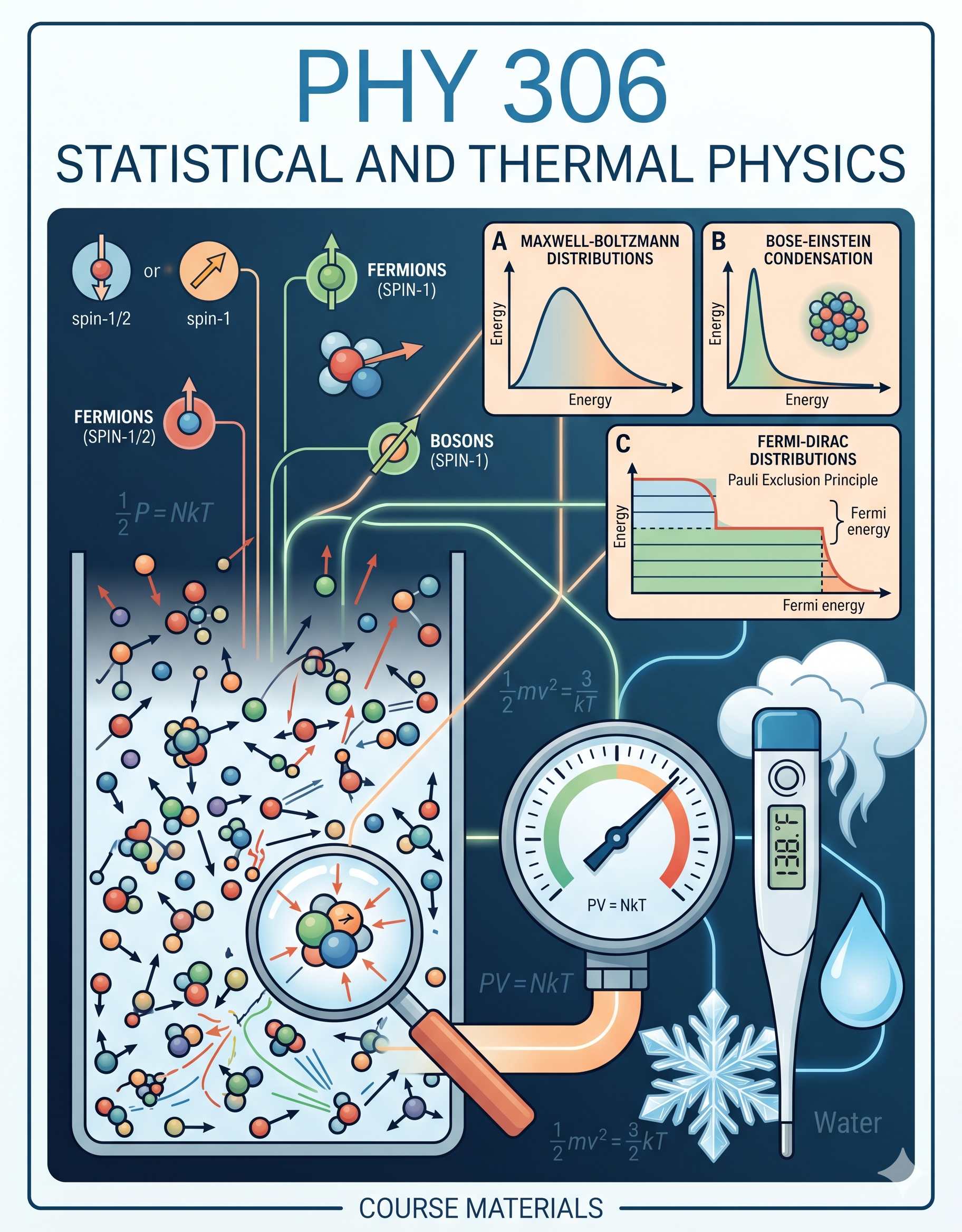
This course provides an overview of Statistical and Thermal Physics, a course that bridges the gap between the unobservable microscopic behavior of particles and measurable macroscopic properties like temperature and pressure. It begins by using the kinetic theory of gases to derive the ideal gas law, demonstrating how macroscopic temperature is actually a direct measure of the average kinetic energy of randomly moving molecules. The text also explores phase transformations, illustrating how variations in temperature and pressure cause matter to transition between solid, liquid, and gaseous states, and defining concepts like the triple point and critical point.
To handle systems with millions of particles where classical Newtonian mechanics falls short, the course introduces statistical distribution functions. It breaks down classical Maxwell-Boltzmann statistics for distinguishable particles at high temperatures , and contrasts it with quantum models where particles are indistinguishable. These quantum models include Fermi-Dirac statistics for fermions (like electrons) that obey the Pauli Exclusion Principle , and Bose-Einstein statistics for bosons (like photons) which are capable of condensing into a single energy state at low temperatures.