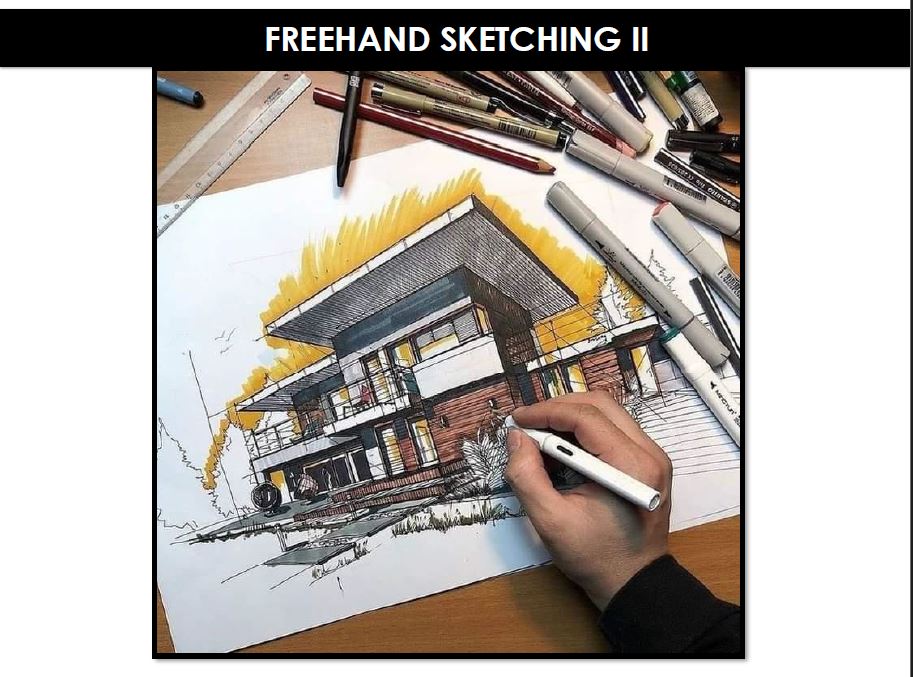
Free hand sketching is a foundational course that teaches students how to draw architectural ideas quickly and clearly without relying on rulers or computer software. The course develops the ability to communicate design concepts through hand-drawn sketches, perspectives, plans, elevations, and shading techniques.
Students learn:
- Basic drawing principles such as line quality, proportion, scale, and composition
- Sketching of buildings, landscapes, furniture, and interior spaces
- Perspective drawing (one-point, two-point, and three-point perspectives)
- Rendering techniques using pencil, ink, or markers to show light, shadow, and texture
- Visual communication skills for presenting architectural ideas creatively and effectively
The course also improves observation, creativity, spatial understanding, and hand–eye coordination, which are essential skills in architectural design and presentation.
CONTENTS
1. VISUAL DESIGN PRINCIPLES (Principles of Art)
2. SHADING
3. ARCHITECTURAL RENDERINGS (monochrome / multi-colour presentation)
4. NATURAL, MAN MADE, LANDSCAPE DRAWINGS (human beings, animals, birds, trees,
vegetation, hills, mountains, sky)
1. VISUAL DESIGN PRINCIPLES (Principles of Art)
There is a great role of Elements and Principles of Design in Architecture and Interior Design. It serves an important purpose of initiating creativity and thereby appreciation of art in many forms. Elements and Principles of Design are the components of Aesthetics. Before examining the basic elements of Aesthetics, it is necessary to understand something of the nature of seeing or observation.
The act of seeing is simultaneously an act of organization. In looking at a piece of Architecture and Interior Design we see the principle visual qualities like mass, form, outline, emphasis, light, shade, texture, pattern etc. Each visual impression evokes in the observer a corresponding emotional reaction. The sum of these impressions creates an emotional state which an Architect must understand and anticipate in order succeeding as a designer.
VISUAL DESIGN PRINCIPLES
Seven principles encompass an interesting design.
1. Balance
2. Rhythm and Repetition
3. Emphasis
4. Proportion and scale
5. Movement
6. Contrast
7. Unity and Variety
8. Harmony
9. Hierarchy
2. SHADING
What is shading in drawing and art?
Shading, in drawing, refers to building layers of pencil to create different tones and contrasts. Pencil marks are blended together to produce darker and lighter areas of a sketch. Shading is widely used to refer to pencil drawings, but you can use the term with other mediums too. For example, if you’re working with a fine liner pen, you can use techniques such as hatching and cross hatching to create a shaded look.
Why is shading important in drawing?
When it’s done well, shading can make drawings look three-dimensional with a variety of textures. Shading can also be used to mimic light and shadow within a picture, which will make your subject leap from the page.
3. ARCHITECTURAL RENDERINGS (monochrome / multi-colour presentation)
MONOCHROMATIC PRESENTATIONS
What are monochromatic colors?
Those who live by the principles of color theory know monochromatic color schemes (or “palettes”) to consist of much more than just “one” color, as the term’s 'mono-’ prefix might suggest. When working with these color choices, it’s important to familiarize yourself with a few key terms:
• Hue: The dominant color family of any particular color (ex: blue)
• Tint: A mixture of a hue and the color white, resulting in a less intense and less saturated look. Tints are also referred to as pastels.
• Tone: A mixture of a hue with gray (made from black and white).
• Shade: A mixture of a hue and the color black, resulting in something darker, richer, and more intense.
So, monochromatic schemes aren’t based on a single color; rather, they’re centered on a single hue. For instance, if you choose a blue monochromatic color scheme, you can use variations of the hue, all made by changing its saturation levels and ending with either the hue itself, or a tint, tone, or shade.
Effective monochromatic schemes create refined simplicity and total visual cohesion. They’re not inherently loud or brassy, but can enhance provocative designs. They also play nicely with well-chosen contrasting colors, and they’re a smart choice for melding your brand to a specific and familiar hue.
4. NATURAL, MAN MADE, LANDSCAPE DRAWINGS (human beings, animals, birds, trees, vegetation, hills, mountains, sky)
APPLICATION OF LIFE AND LANDSCAPE ELEMENTS TO DRAWINGS
A landscape is part of the Earth’s surface that can be viewed at one time from one place. It consists of the geographic features that mark, or are characteristic of, a particular area.
A landscape is part of the Earth’s surface that can be viewed at one time from one place. It consists of the geographic features that mark, or are characteristic of, a particular area.
What is a natural landscape?
Natural landscapes are those physical spaces that have not been modified by the hand of the human being. A natural landscape is when an area of land and the elements that are on it are not directly changed, altered, or moved by humans. These types of elements can be non-living or living.
- Lecturer : charles chukwu
- Lecturer : Ukamaka Chioma Emakpor